Snake scales, owl feathers, hedgehog spines and rock surfaces sit side by side in the sensory zone of the S16-1 Hapti Touch Board - Touch the Nature. The textures reproduce animal coverings and elements of nature, so each panel leaves behind knowledge of the natural world, not just a stimulus. It stands in nurseries, schools and education centres.
Play starts with the hand. The child moves it across the successive fields of the sensory zone and guesses what they feel: rough here, grooved here, smooth here - and only then checks what motif lies under the texture. Why touch, of all things? Because a surface can be recognised without looking: you just run your hand over it, and the difference between two neighbouring fields can be felt straight away. Haptic boards also have therapeutic uses: they support sensory integration and work well with children with autism, ADHD and sensory processing disorders.
The board works outdoors all year round, including winter - there is no need to put it in storage for the season. Where does this resistance come from? The frame is steel, galvanised and powder-coated, so rain and frost leave no rust on it, and the print is sealed under UV-resistant varnish so the designs do not fade in the sun. The equipment has a declaration of conformity and a certificate from an accredited body, and its durability is backed by a warranty. The manufacturer is EduPlayground, and the board is made in Poland.
Touch trains precise hand movements
Recognising a texture is a job for the fingertips: the hand slows down, a finger passes over a bump and returns to the smooth field to compare one with the other. This is how fine motor skills and hand coordination are worked - the movement is small and precise.
Accessible to blind children too
The board's content is read by touch, and raised structures and high-contrast markings can be recognised without sharp eyesight. A blind or partially sighted child learns the same things at it as the rest of the group, at the same time.
Naming what's under your fingers
A texture has to be named: rough, smooth, grooved, raised. Children compare neighbouring fields, describe them and look for the features that tell one surface from another - and along the way their vocabulary for touch grows.
What makes up the Hapti board
Five elements: four work under the fingers, and the fifth sets the board at the height of the group's hands.
Sensory zone with textures
A separate field of the board brings several different surfaces together side by side, so comparing them takes a moment: the finger moves from one texture straight onto the next. The hand travels along the board and checks field by field, in any order.
3D-printed structures
The textures are made using 3D printing, which reproduces the bumps, grooves and roughness of a surface. They differ from a flat graphic in that they stand out from the board - the fingertip feels the shape, not just the picture.
Built-in self-checking
The task is to match a texture felt by touch to the right motif, and correctness is checked on the spot, without asking an adult or waiting for a mark. The child corrects themselves, so they try again straight away.
Descriptions in Braille
The textures have descriptions in Braille beside them, and the labels are kept in high contrast. A blind child reads the name with their fingers, and a partially sighted child recognises the field by its contrast - both use the board without help.
Adjustable frame height
The board's height is set during installation: lower where pre-schoolers come up to it, higher where older pupils use it. The texture zone should stay at hand height for the group that uses the board most often.
Personalisation
Hapti board with your own topic, textures and colour
The three ready-made editions do not always cover the topic the setting is working on. Personalisation does not change the board's construction or installation. The scope of the design is agreed with an adviser.
Board theme and graphics
The topic and graphics of the board are designed to order for a chosen scope: the setting's programme, therapy sessions or the nature of the local area.
Textures to touch
The textures to touch are chosen to match the ordered theme, so that what the child feels with their fingers corresponds to the motifs visible in the graphic.
Braille labels
Braille labels are prepared for the board's new topic, so a blind child reads with their fingers the names of the same motifs the others see in the graphics.
Colour
The colour of the frame can be adapted to order - a frequent request. The scope of the change is agreed with an adviser. Standard colour according to the product data sheet: green (RAL 6018).
Before the board goes into the playground, our adviser will help you plan all the technical details. We are with you at every stage of the project, sharing our knowledge and experience so that the equipment serves children as well as possible for many years.
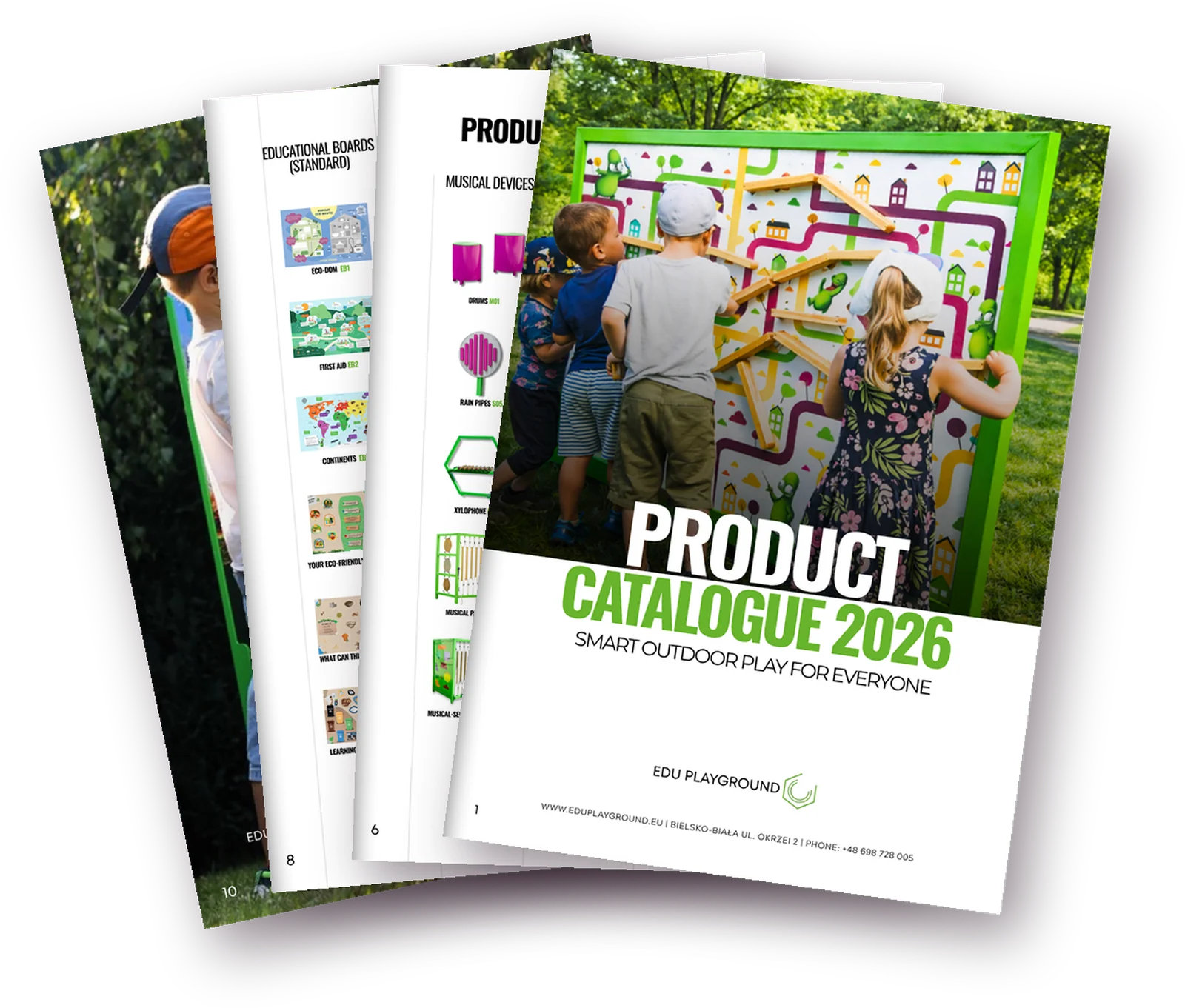
Once you enter your email address, the catalogue of science, sensory and therapeutic equipment is sent to your inbox.
Cookie consent
With your consent, this site uses cookies for statistics and advertising. Without consent, the site works fully. You can change your choice at any time via the ‘Cookie settings’ link in the footer. Privacy policy