Astronomy and stargazing

L2A Double Astronomical Telescope

The L2A Double Astronomical Telescope is an outdoor observation station for two people at once. Two tubes pointed at the sky - a lower one for children, a higher one for teenagers and adults - with 45× magnification and a 90 mm objective lens show the craters and mountains of the Moon, and Jupiter with its cloud bands and four moons. It works well in schools.

Safety certificate
EN 1176-1
Warranty
2 years
Made in
Poland

Product description

The objective lens gathers light, the eyepiece magnifies it

It all starts at the eyepiece. The child puts an eye to it, slowly turns the focus and watches a blurred patch turn into the craters of the Moon or a bird on a branch several hundred metres away. What happens inside the tube? The objective lens gathers light from a distant object and forms an image, and the eyepiece magnifies that image. The idea is not new: in 1608 the Dutch spectacle maker Hans Lippershey put two lenses together and brought a distant church closer, a year later Galileo Galilei pointed such a telescope at the sky, and two hundred years after him John James Audubon drew the birds of America through one.

The telescope is sealed, and the galvanised, powder-coated frame withstands rain, frost and sun. It works in summer and winter without being put under cover, and the tube is mounted on a post permanently anchored in the ground. The image in the eyepiece is upright, not inverted, so a tree in the telescope stands the same way as it does in the landscape. A telescope is never pointed at the Sun without a filter; the glass solar filter screws only onto the objective lens of the astronomical telescope tube. The equipment works outdoors all year round and is covered by a warranty. The manufacturer is EduPlayground, and the telescopes are made in Poland.

Attentiveness that takes time

Before anything can be seen, the tube has to be aimed, the image focused and the target kept in view. This chain of actions takes a few minutes and the reward only comes at the end, so at the telescope the child practises concentration and patience.

Optics children ask about unprompted

Why does glass bring things closer? Why adjust the focus? Why does a bigger objective lens give a brighter image? These questions come up at the telescope on their own, and the answers are the basics of optics - material that comes back later in physics lessons.

Practising distance and scale

A bird a hundred metres away, a roof across the river, the Moon above the rooftops. Moving between targets like these, the child estimates distances and compares sizes, and the word ‘far’ stops meaning everything at once.

What's inside the telescope

Five elements: three decide what you see and how, and two provide a steady base and comfort at the eyepiece.


Tube with objective lens

The objective lens at the front end of the tube gathers light, and its diameter determines how bright the image is: the larger it is, the more you can see in poor light. The tube itself sets the distance between the lenses and shields them from light coming in from the side.

Front sight, rear sight and lock

The tube turns all the way round and tilts upwards. To find a target, you release the lock, guide the tube using the front and rear sights, and once the target is lined up, lock it again. Only then do you put an eye to the eyepiece and set the focus.

Eyepiece and focus knob

You put your eye to the eyecup and set the focus by slowly turning the eyepiece until the image stops being a blur. Everyone sees slightly differently, so each person adjusts it for themselves. Anyone who wears glasses takes them off and sets the focus for their own eye.

Permanently anchored post

The telescope stands on a post fixed to the ground, not in someone's hands. At this magnification, the slightest tremor of the hand shifts the image by hundreds of metres across the landscape, so only a steady base lets you look calmly and show the same thing to the next person.

Step included

A footstep comes with every telescope, including the landscape ones. It stands by the post and lets smaller children reach the eyepiece without an adult's help, so children of different heights can take turns at one telescope.

Add-on: solar filter

The solar filter is glass, not film, and screws onto the telescope's objective lens. It blocks 99.99% of light as well as UV and infrared radiation. When the blade of the solar sight casts a shadow on the crosshair with a dot, the Sun is in the field of view. The filter is fitted and removed by the teacher, and the Sun is only observed with an adult present. After the lesson, the filter goes back in its box. A cracked or scratched filter must not be used. It can be bought later - the telescope is ready for it.

Specification

Technical data

Front view - from technical drawing L2A.
Catalogue no.L2A
Dimensionslength: 120 cm | width: 58 cm | height: 185 cm
Optics2 tubes, each: 45× magnification, 90 mm objective diameter; upright (non-inverted) image
Range of movementrotation 360°, vertical from 0 to approx. 75°
Safety zone3.76 x 4.06 m
Children's agefrom 6 years
MaterialCast aluminium construction.
ProtectionGalvanised, powder-coated frame
ColourGreen (RAL 6018); any RAL colour on request
InstallationGalvanised steel anchors L=75 cm, set in the ground and concreted in; bolted connection to the equipment.
Safety standardEN 1176-1
Main categoryAstronomy and stargazing
Country of originPoland
Warranty2 years

For tenders

Technical documentation

Full design pack for tenders:

  • 2D viewsPDF · 2 files
  • CAD drawingsDWG · 2 files
  • 3D modelSTL

Once you enter your email address, the pack is ready to download straight away and the link is also sent to your inbox.

Gallery

Telescopes in action

See installations →

Before you choose a telescope

Which telescope to choose and where to put it

The telescope version, where it stands and the colour of the frame depend on what the setting wants to observe and the view it has from the site. Each of these decisions is discussed with an adviser.

Related products

From the same category: astronomy and stargazing

See the whole category →

Before it is installed

Siting and installation with an expert

Before the telescope goes into the playground, our adviser will help you plan all the technical details. We are with you at every stage of the project, sharing our knowledge and experience so that the equipment serves children as well as possible for many years.

Export

Urszula Brzóska, Head of Export Department

Urszula Brzóska (Mrs.)

WhatsApp +48 698 728 005u.brzoska@npz.edu.plWrite to me on Facebook

Head of Export Department

Customer service office: office@eduplayground.eu

Catalogue to download

The whole range in one file

Once you enter your email address, the catalogue of science, sensory and therapeutic equipment is sent to your inbox.

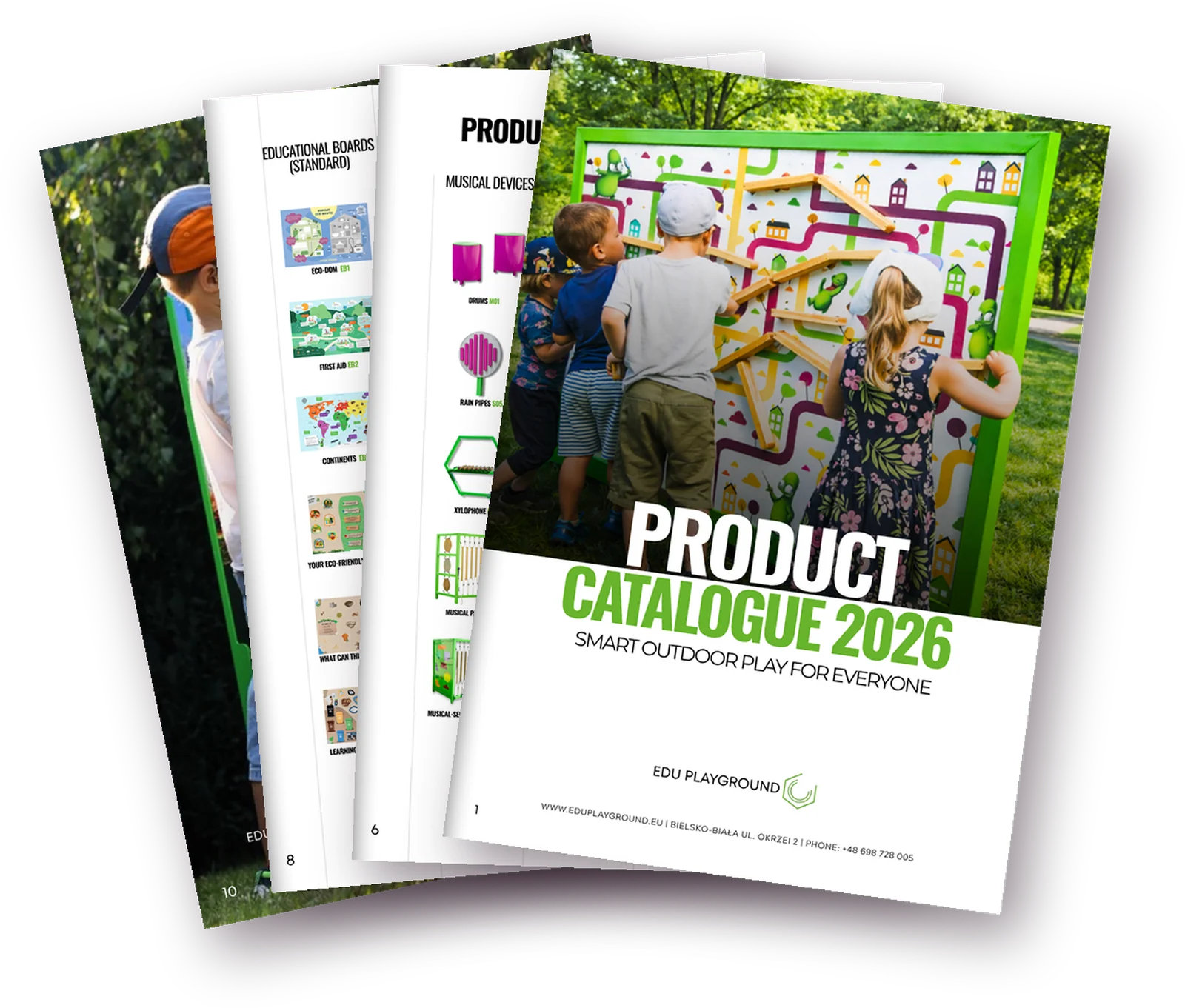
EduPlayground 2026 product catalogue - the cover and open pages with an overview of equipment and educational boards